HCLSoftware’s Richard Jefts and Andrew Manby led an insightful webinar on citizen development last week. Moderated by Wade Roush, the webinar covered a range of topics related to trends in no code/low code development, how AI can contribute to no code development, and the importance of giving citizen developers the tools they need to build business-focused apps while still allowing IT to manage security and governance. If you missed it live, you can register for the replay here.
Key takeaways:
- No code isn’t new, but what’s changing now is that organizations are ending up with too much IT complexity and shadow IT environments, resulting in big backlogs.
- A cultural shift away from fusion teams, where only IT is developing apps, is needed. Citizen development platforms that span the full spectrum from no code to pro code can give business users the tools they need to develop their own apps while enabling IT to still maintain control and governance over the environment.
- Organizations that adopt a limited approach – squeezing the citizen development within a small deployment in specific departments – can only release a small number of projects and don’t get the velocity needed and all the benefits possible.
- HCL is seeing applicability and successes across education, manufacturing, oil and gas, beverage industry, and many more.
- Security and compliance, lack of IT governance, and gaps in skills and training were the top concerns cited by webinar participants when polled. This highlights the importance of working with a vendor that can provide the necessary controls for security and governance in the platform.

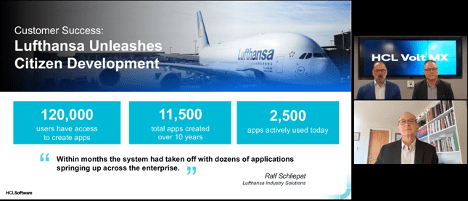
Richard and Andrew shared the success Lufthansa is having as it leverages citizen development for simple to complex apps, like ordering crew uniforms, event registration, and mobile applications for cleanliness surveys. Their goal is to drive a delightful experience for their customers, and they see putting development tools into the hands of over 120,000 employees as a key enabler towards that goal. In over 10 years of doing citizen development, they’ve created 11,500 apps, with 2,500 still in production today.
In response to a question on seeing the value of collaborative development without losing control of data, Richard and Andrew stressed how with the right solution, you can govern and control access for any given data source, only giving access to those who need it. It doesn’t need to be an all or nothing approach.
The impact of AI on citizen development was also an important topic discussed. There are three buckets where AI can play a role:
- Automated app creation
- Developer productivity
- Data capture and analysis
For example, users of HCL’s citizen development platform, Volt MX, can leverage AI today to build prototypes of an application, greatly reducing the time needed to get the app built and deployed.
Some final thoughts from the speakers:
- Richard Jefts: It’s time to embrace citizen development. Many companies are already moving in this direction. As we involve, you can see where you want the LOB to be much more engaged in what is being built for internal and external use.
- Andrew: Just do it. Each organization needs to think about the formula that will work best for their business, their risk tolerance, and how they run governance. And then just try it. Major organizations are already doing it, and small businesses are doing the same thing. Unleashing innovation is the main thing.
Replay link: Empower Citizen Developers to Accelerate Innovation
Free Account: Try HCL Volt MX for free
 Adam Gartenberg